
Learn how to use AI without losing your voice when creating content in a way that naturally reflects real thought, real presence, and your lived experience.
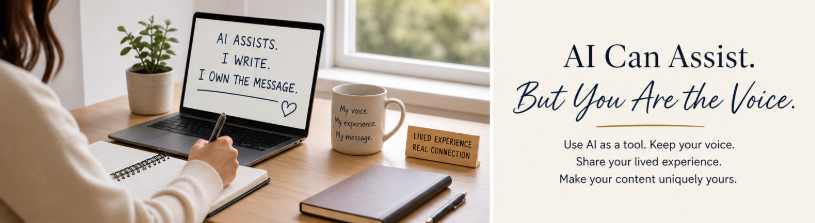
There’s a growing concern about AI-generated content and it’s not without reason.
Moreover, many readers can now recognize it almost immediately. Not because they were trained to identify it, but because something feels off.
The writing may be polished, structured, or may even be informative. But it often feels… distant.
For example, you begin to notice familiar patterns:
- Repeated phrases
- Predictable sentence structures
- A tone that feels uniform across different articles
And after a while, it all starts to sound the same. So, the question becomes:
Is AI the problem? In my experience, no. The issue is not AI itself. However, it’s how it’s used.
The Difference Between Assistance and Replacement
There is a clear difference between:
- Using AI as a tool
- And allowing AI to become the voice
When AI becomes the voice, content starts to feel mass-produced. On the contrary, when AI is used as a tool, the writer remains present.
That presence is what readers connect with even if they can’t quite explain why.
Your writing should share information in a way that your message is received and experienced.
I Use AI for various aspects of my life, but I don’t hand over my voice. Moreover, I want to be transparent. I use ChatGPT as part of my writing process.
I use it to:
- Expand on ideas
- Help organize my thoughts
- And provide structure when needed
But I do not rely on it to speak for me. It’s important that the message itself comes from me. And that distinction matters.
When the message comes from you, it carries something AI cannot reproduce. For instance, it shows your perspective, thought process, and lived experience.

I’m Still Learning This Too and Adjusting Along the Way
This is not something I’ve perfected. I am still learning how to refine my use of AI in writing. Even with intention, generic language can slip through. And it’s not always obvious.
Sometimes it’s not the overused words people often point out.
Quite often, it shows up more subtly:
- Sentences that feel too balanced
- Phrasing that sounds polished but not natural
- A tone that doesn’t quite match how I would actually say something
That’s where awareness becomes important.
It’s Not Just Words—It’s the Patterns Behind Them
The above subheading is a typical example. AI, in addition to generating content, generates patterns.
If we’re not mindful, those patterns can shape our writing in ways that don’t reflect who we are.
Repetitive Language Patterns
We often focus on avoiding certain words. But it’s also:
- Sentence rhythm
- Structure
- Predictability
When everything flows too smoothly, it can begin to feel impersonal.
Natural writing has variation, pauses, as well as reflecting thought in motion.
Punctuation That Feels Mechanical
This is something many people overlook. AI tends to lean toward:
- Frequent use of em dashes
- Structured, almost formulaic comma placement
- Repeated formatting patterns
There is nothing wrong with these tools. But when overused, they begin to stand out. And instead of supporting the message, they can make the writing feel mechanical.
Emoji Usage That Doesn’t Align
Emojis can enhance communication, but only when used intentionally. You may notice AI often:
- Inserts them unnecessarily
- Uses them too frequently
- Selects ones that don’t match your tone
If emojis are part of your natural communication, use them. If not, there is no need to force them into your writing.
The “Too Perfect” Effect
Sometimes content looks flawless, but it feels distant. That’s usually a sign that it hasn’t been:
- Filtered through personal thought
- Grounded in real experience
- Refined beyond the initial draft
However, perfection is not the goal. Connection is.

What Makes Content Truly Yours
There is one thing AI cannot replicate: Your lived experience.
It cannot:
- Replace your personal journey
- Reflect your real-life interactions
- Speak from what you have seen, done, or learned firsthand
That is where your content becomes uniquely yours.
My Process | “De-AIing” My Content
One of the ways I maintain my voice is through what I refer to as “de-AIing” my work.
I enjoy writing and editing. So, even when I use AI, I take time to go back through the content, often without any AI assistance, and refine it in my own words.
That process matters to me. It allows me to:
- Reconnect with what I’m saying
- Remove anything that doesn’t sound like me
- And ensure that the message reflects my voice and my intent
AI may help shape the draft, but I shape the final message.
A Perspective from My Administrative Experience
Before AI became part of my writing process, I spent years in the secretarial and administrative field.
Part of my responsibility was researching and preparing reports and other documents on behalf of my managers.
The final documents carried their names and signatures. However, I did the work behind the scenes.
Those reports were not written in my voice. They were written in theirs.
Over time, I became familiar enough with each individual to understand how they communicated. I knew how to adjust tone, structure, and wording to reflect their voice accurately.
That experience stayed with me. Today, as I use AI in my writing process, I see a similar dynamic.
AI can assist with compiling, structuring, and expanding content. Ultimately, it is still my responsibility to ensure that what is presented reflects my voice.
Just as I once wrote on behalf of others, I now make sure that anything I publish—whether AI-assisted or not—remains aligned with my own tone, my own perspective, and my lived experience.
That background has given me a deeper appreciation for this process. Moreover, I understand what it means to shape a message intentionally.
Simple but Powerful Techniques
Rephrasing
Sometimes a sentence sounds fine but feels familiar.
For example, a line like:
“Writing is not just about delivering information. It’s about connection.”
There’s nothing wrong with it. However, it carries a rhythm that shows up often in AI-assisted writing.
In those moments, I:
- Rephrase it in my own words
- Ask for alternative versions
- Or adjust it until it reflects how I would naturally say it
Sometimes the shift is small, but it makes a difference.
Setting Boundaries When Using AI
Another practical approach I use is setting boundaries in my prompts.
At times, I may request:
- That certain words not be used
- That the tone be more natural
- That the structure avoid clichés or overused patterns
This helps reduce repetition and keeps the content closer to my voice.
A Practical Workflow You Can Follow
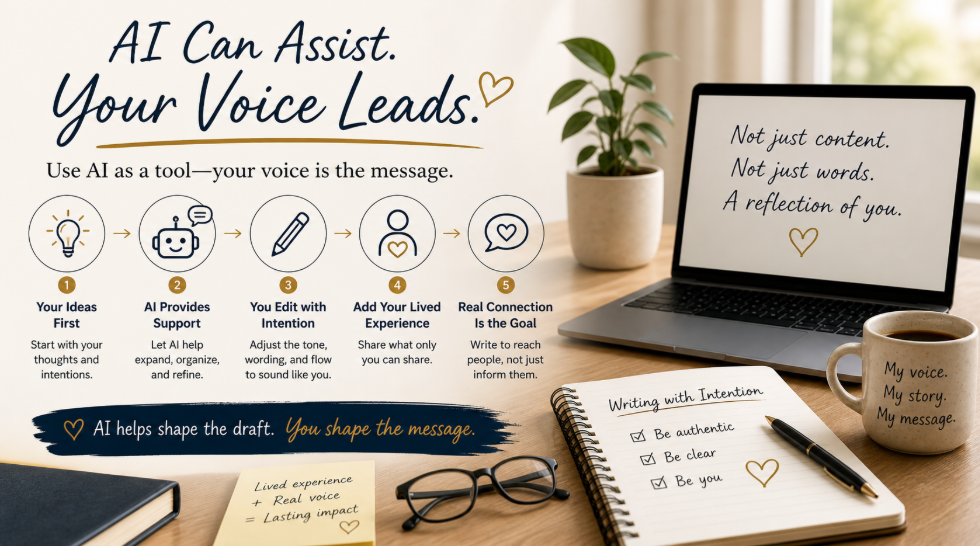
If you’re looking to use AI without losing your voice, here’s a simple process you can try:
1. Start With Your Own Thoughts
Write a few sentences in your own words before using AI.
2. Use AI to Support, Not Replace
Let it help expand or organize your ideas.
3. Edit With Intention
Look beyond grammar, focus on tone, flow, and authenticity.
4. Add Your Lived Experience
This is what makes your content unique.
5. Read It Out Loud
If it doesn’t sound like you, revise it.
Give Yourself Room to Grow
This is a learning process. I am still learning, and that’s part of the journey.
The more you work with AI, the more you begin to recognize:
- What aligns with your voice
- What doesn’t
- Where small adjustments make a meaningful difference
Why This Matters
As more content is created using AI, authenticity becomes more valuable. Readers may not always be able to explain it, but they can feel when a:
- Message is genuine
- Voice is present
- Writer is truly behind the words
That’s what builds trust.
A Closing Thought | Don’t Lose Your Voice to AI
Finally, I’m not aiming for perfection in AI-assisted writing.
Instead, I’m aiming for alignment. The message still sounds like me, feels like me, and the content is mine from a lived experience.
Most importantly, every piece of content leaves an imprint. And that imprint should be real.
If you’re exploring ways to build, write, and grow your presence online, I share tools and platforms that have supported me along the way.
Remember, every step you take leaves an imprint. If you’d like to explore resources that align with building with intention, you’re welcome to do so at your own pace.
(Some of these may be affiliate links, which means I may earn a commission at no additional cost to you.)
Veron | Entrepreneur | The Way 4Word Enterprises | Premium Member, Wealthy Affiliate